

Article by
Gabi
Hi, I'm Gabi - Co-Founder of Bestever Pics. Thanks for visiting our blog. We are working hard to produce content which we hope resonates with you. Feel free to drop us a line on socials or via the contact form on the site.
What if the most stressful part of your celebration isn't the $33,000 average budget, but the 42 open browser tabs currently fighting for your attention? You've likely realized that wedding planning often feels like a second full-time job where every influencer contradicts the last one. It's normal to feel anxious about hidden venue fees or worry that you'll miss the small, candid moments while the professional photographer is busy with formal portraits. You want your day to be about the people, not just the logistics.
You deserve a celebration that feels like a party, not a project management crisis. This guide provides a practical, step-by-step framework to master your 2026 details with total confidence. We'll walk through a logical timeline, build a realistic budget that accounts for 5% annual inflation, and show you how Bestever.pics helps you capture every guest's perspective without adding to your stress. From the first deposit to the final dance, you'll have a clear path forward.
Key Takeaways
- Define your "Big Three" early to ensure your budget, date, and guest count stay aligned with your vision.
- Organize your wedding planning with a 12-month timeline that prioritizes booking high-demand vendors before their calendars fill up.
- Move beyond traditional guestbooks by using modern tech to capture candid moments from your guests' perspective.
- Understand why a designated day-of coordinator is essential for managing logistics so you can actually enjoy your celebration.
- Master the transition from event execution to post-wedding tasks to keep your first weeks of marriage stress-free.
What is Wedding Planning? A Modern Definition for 2026
Wedding planning is the strategic process of coordinating logistics, finances, and design to create a cohesive marriage celebration. In 2026, it prioritises digital integration and guest-centric technology over traditional paper-heavy methods. It involves managing vendors and budgets while balancing personal vision with practical constraints to ensure a stress-free experience.
Wedding planning is the bridge between a couple’s vision and a guest’s comfort. It's no longer just about picking flowers or tasting cakes. It's about architecting an environment where every detail, from the digital RSVP to the late-night transport, feels intentional. Modern couples use tools like Bestever.pics to visualise their concepts instantly, replacing the slow mood boards of the past. Understanding What is a Wedding Planner? provides a clear baseline for the level of organisation required, whether you're DIYing the day or hiring a professional.
The Core Elements of an Organised Celebration
Establishing a realistic budget is your first non-negotiable task. In the current Australian market, costs for premium venues have risen by 5.5% over the last twelve months. You must account for a 10% contingency fund to handle unexpected price hikes or last-minute logistics. This buffer ensures that a sudden change in weather or a vendor swap doesn't derail your entire financial plan.
Defining your style early prevents expensive pivots later. You might lean toward a traditional formal setup in Melbourne, a relaxed coastal vibe in Byron Bay, or even a high-energy "Schoolies-style" celebration for a younger crowd. Whatever you choose, the guest experience must remain a primary planning pillar. Guests in 2026 expect intuitive digital schedules and dietary-aware catering that feels inclusive rather than like an afterthought.
- Budgeting: Locking in a total spend with a 10% safety net.
- Style Definition: Selecting a theme that dictates every visual choice.
- Guest Logistics: Prioritising comfort through tech-driven communication.
Why Intentional Planning Beats Perfection
Decision fatigue is a significant threat to your sanity. You'll likely face over 150 individual choices during the 12-month lead-up to your wedding. To combat this, identify three non-negotiable priorities early. If the food, the music, and the photography are your top three, you can afford to be flexible on the rest. This focus keeps your energy where it matters most.
Involve your partner without turning every dinner into a boring committee meeting. Set specific "wedding-free" nights to maintain your relationship outside of the logistics. We've seen a massive shift from "showcase weddings" designed for social media to "experience-driven" gatherings. Couples now prioritise the atmosphere and the flow of the night over rigid, outdated traditions. It's about creating a day that feels like a genuine reflection of your life together, not a performance for a gallery.
Setting Your Foundation: Budget, Date, and Vision
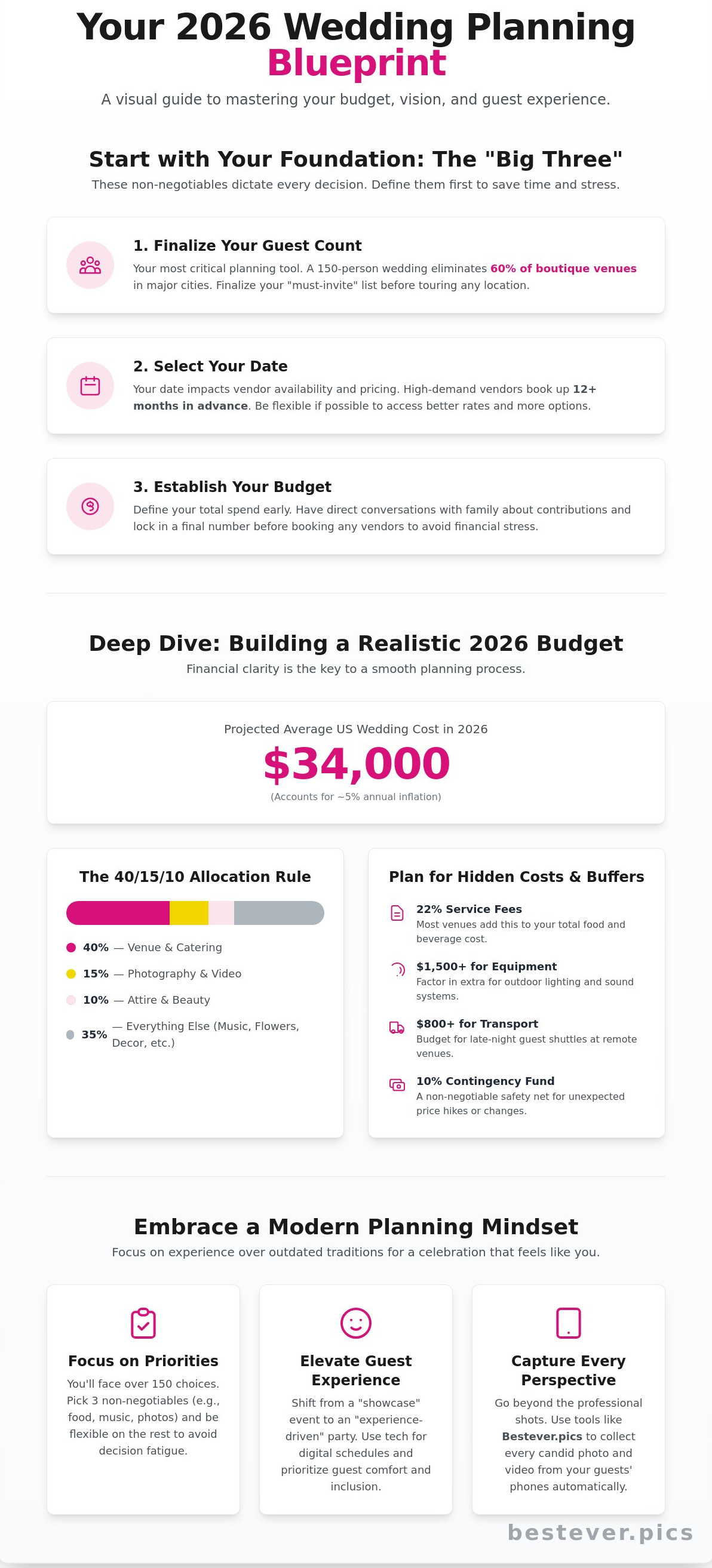
Success in wedding planning depends on three non-negotiables: your total spend, your preferred date, and your final headcount. These "Big Three" dictate every subsequent choice you make. If you don't define these early, you'll waste weeks touring venues that are too small or too expensive. Start with the numbers to build a framework that actually works.
Your guest list is your most important planning tool. A 150-person wedding eliminates 60% of boutique venues in major cities like New York or Austin. Finalize your "must-invite" list before you look at a single floor plan. This prevents the frustration of falling for a space that fits 80 people when your family expects 120. Once you have a number, you can filter venues by capacity and realistic catering costs.
Building a Realistic 2026 Wedding Budget
In 2026, the average US wedding is projected to cost $34,000. To keep your finances on track, use the 40/15/10 rule. Allocate 40% for the venue and catering, 15% for photography and video, and 10% for attire. It's smart to review this Financial Checklist for Couples to ensure your long-term goals align with your celebration spend.
- Service Fees: Most venues add a 22% service charge to food and drink.
- Equipment Hire: Expect to pay $1,500 extra for outdoor lighting and sound systems.
- Logistics: Budget at least $800 for late-night guest shuttles if your venue is remote.
Talk to family members early about financial contributions. Be direct and use specific numbers. Ask for a set dollar amount instead of a vague percentage. This clarity prevents "the talk" from becoming a source of drama later in the process. It's about setting boundaries before the first deposit is paid.
Finding the Perfect Venue and Date
Tour venues with a critical eye for technical details. Check for high-speed Wi-Fi and accessible power outlets for your vendors. On-site weddings are a massive trend for 2026 because they simplify logistics. Keeping the ceremony and reception in one spot reduces travel time and keeps the energy high. If you're designing your own digital invites or a custom website, Bestever.pics can help you create professional-grade visuals for your wedding assets in seconds.
Check the local calendar for "blackout" dates. Avoid major sporting events like the Super Bowl or holiday weekends like Labor Day. Hotel rates often triple during these windows, which puts an unfair burden on your out-of-town guests. Micro-weddings are also surging in popularity. Many 2026 couples are opting for guest lists under 40 people to prioritize high-end dining and luxury experiences over a large, impersonal crowd.
Modern Guest Engagement: Beyond the Traditional Guestbook
Traditional guestbooks often fail to capture the real spirit of the day. Data suggests that up to 70% of guests skip the signing table entirely, leaving you with a half-empty book that eventually gathers dust in a cupboard. It’s a static relic in a world that moves at the speed of a smartphone. You spend months on wedding planning to create a perfect atmosphere, yet the guestbook often feels like a chore rather than a celebration.
Bridging the gap between professional shots and guest candids is vital for a complete memory set. Your photographer handles the high-stakes portraits, but your friends capture the 1:00 AM dance floor chaos. The hurdle is "App Fatigue." A 2023 survey revealed that 75% of people won't download a new app just for a single event. They want to snap, share, and get back to the party. Position your photo collection as a fun activity. It shouldn't feel like homework for your guests.
The Rise of the Digital Guestbook
A digital guestbook moves your memories into the cloud. These solutions allow for instant, high-resolution uploads from any smartphone without a login. You can integrate QR codes into your table decor, bar signage, and "Order of Service" cards. This doesn't just cover the wedding day. It’s a space to store the messy, fun moments from the hen party and stag do leading up to the main event. Everyone sees the full story in one shared gallery.
Collecting Memories Without the Stress
The smartest way to collect guest photos is through a browser-based system like Bestever.pics. It eliminates the need for downloads and keeps things simple. Older guests aren't left out; if they can scan a menu at a restaurant, they can upload a photo here. It’s about accessibility. You’ll wake up the very next morning with a gallery of hundreds of photos from your guests' perspectives. It provides immediate gratification while you wait for your professional edits.
Modern wedding planning prioritises these "micro-moments." When you make sharing effortless, you get more than just a signature. You get a visual history of the day from every angle. This approach turns every guest into a contributor to your story. It’s efficient, it’s fast, and it ensures no memory is lost to a forgotten camera roll. You get the professional polish from your photographer and the raw, authentic energy from your friends.
Your 12-Month Wedding Planning Timeline and Checklist
Effective wedding planning requires a clear roadmap to keep your sanity intact. In the UK, the most popular venues often book out 18 months in advance for peak summer Saturdays. You'll want to lock in your high-demand vendors, like photographers and live bands, at least 12 months before the big day. These professionals usually only handle one event per date, so hesitation often means missing out on your first choice.
- 12+ Months: Secure your venue and primary vendors. This sets your date and budget floor.
- 9-10 Months: Finalise your guest list. You can't accurately price catering without a solid head count. Send your Save the Dates and start shopping for attire.
- 6 Months: Book transport and order your physical invitations. This is also when hen do or bachelor party logistics should be settled.
- 3 Months: Finalise the menu with your caterer and buy your wedding bands. Confirm the "run-of-sheet" with every vendor to ensure everyone's on the same page.
- 1 Month: Lock in the seating chart. Ensure your [LINK: digital guestbook] QR codes are printed and ready for display.
The Critical Six-Month Mark
At the six-month point of your wedding planning journey, focus on the details that impact your aesthetic and guest experience. Confirm floral designs based on seasonal availability; for example, UK peonies are typically only available from May to early July. Organise your first dress fittings or suit hire now. You'll likely need three separate appointments to get the fit perfect. Start chasing RSVPs early. Statistics show that roughly 15% of guests will miss the deadline, so prepare a polite follow-up message to send 48 hours after the cutoff.
The Final Countdown: 30 Days to Go
The last month is about verification. Conduct a final venue walkthrough to check for power points and Wi-Fi signal strength. If you're using Bestever.pics to collect guest photos instantly, you'll want to ensure the reception space has reliable connectivity. Write your vows now so they aren't a last-minute stressor. Keep speeches under five minutes to maintain the evening's energy. Finally, pack a "Day-of" emergency kit with safety pins, mints, and phone chargers to handle any minor hiccups.
Managing the Big Day: Execution and Post-Wedding Tasks
Your wedding day shouldn't feel like a shift at work. You've spent 12 months on wedding planning; now it's time to actually attend the party. The most successful couples share one secret: they hire a day-of coordinator. This professional takes over the logistics 48 hours before the ceremony. They handle everything from the florist's late arrival to the misplaced buttonholes. If a professional isn't in your budget, assign a Logistics Lead who isn't in the wedding party. This person answers the phone so you don't have to.
Managing the timeline requires a light touch. Avoid scheduling every minute like a military operation. Instead, build in 20 percent more time than you think you need for every transition. If hair and makeup takes 60 minutes, put 75 minutes in the diary. This buffer prevents the rushed feeling that kills the mood. You want to glide between events, not sprint through them.
Your timeline should be a guide, not a cage. If the wedding breakfast runs 15 minutes late because the speeches were particularly moving, let it happen. A rigid adherence to the clock creates visible tension. Focus on the energy of the room rather than the hands of your watch. [LINK: wedding day schedule tips]
Surviving the Wedding Day with a Smile
Eat a substantial breakfast at 8:00 am. It's easy to forget food when the adrenaline hits, but a blood sugar crash at the altar is a disaster. Keep a bottle of water and a high-protein snack in your dressing room. Use the 5-minute rule for any hiccups. If a minor issue won't matter in five years, give yourself exactly five minutes to be annoyed, then move on. To capture every moment, place QR codes on every table and at the bar. Guests are 40 percent more likely to upload photos when they see a clear, physical prompt near their drinks.
Wrapping Up: The First Week of Marriage
The party ends, but the memories shouldn't sit in a digital cloud. Within the first 72 hours, download your full digital album from Bestever.pics to secure those candid guest shots. You'll find angles your professional photographer missed. Send digital thank-you notes within 14 days. It's faster and feels more personal when you include a link to the shared gallery for everyone to enjoy. This turns a simple chore into a shared experience for your guests. [LINK: post-wedding photo sharing]
Finally, handle the legalities. Order your official marriage certificate from the General Register Office for £12.50. This is the foundation of your new life together. Get the paperwork sorted before you head off on your honeymoon to avoid a backlog of admin when you return. Your wedding planning journey is officially complete when the last photo is archived and the last thank you is sent. You've built a legacy; now make sure it's preserved for the next fifty years.
Ready to see your wedding through your guests' eyes? Start your shared gallery at Bestever.pics today and capture every unposed moment effortlessly.


